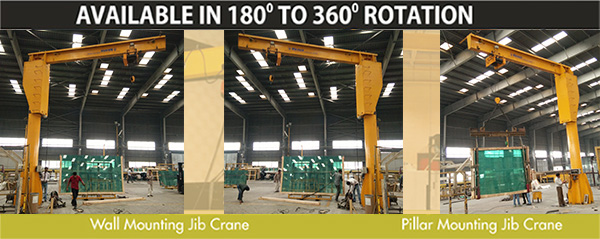
A jib crane is a sort of
crane that regularly ranges between two focuses and can move weighty items. Jib cranes come in different sizes and
shapes. Most regularly they are viewed as an outline structure with a one-arm
expansion at a point from the fundamental bar. These cranes are useful for
moving huge bits of hardware or gear on building locales. They are additionally
generally of purpose in distribution centers, production lines, power plants,
ports, and numerous different spots where hard work needs to occur.
WHAT IS A JIB CRANE?
A jib crane has a
level arm, known as the jib or blast. A jib, which resembles a gantry, upholds
a portable derrick that might be on the wall or support point on the ground. A
jib's essential capability is in modern settings. For instance, a jib crane can
lift weighty items onto high retires or get them across enormous distances.
A jib swings in a circular
segment or is held so it considers a more sidelong development. The jib on the
crane is a shifted swagger whose capability is to help with the decent pulley
lock. More or less, a jib crane is
above lifting hardware that is useful in more modest work areas for tedious and
explicit lifting errands.
With an essential
comprehension of what a jib crane is, you ought to likewise realize how it's
made. In contrast with different kinds of cranes, for example, workstation
cranes or gantry cranes, the crucial construction plan of a jib crane is easier. Thus, they are
additionally more straightforward to work and don't need a lot of upkeep.
JIB CRANE COMPONENTS
Jib
cranes are typically very fundamental in plan and
development. They are simpler to work and require less fixing than workstations
or scaffolds or gantry cranes. This is on the grounds that they have less parts
that could fall flat or separate.
THE MAIN COMPONENTS OF JIB CRANES ARE:
● The
Reach - An even shaft that swings to and fro on the streetcar. The unsupported
or pole jib crane blast can pivot
360 degrees. Though the revolution on a wall or section-mounted crane is
somewhere in the range of 180 and 200 degrees.
● Pole/Pillar
- This upward bar upholds the blast on frameworks with either a pole or is
detached.
● Mobile
Hoist - A derrick is a gadget that raises, positions, and brings down a heap.
● Streetcar
- The streetcar might be hand-controlled, fueled, or pneumatically worked. The
streetcar moves the lift, wire rope or chain, and snares along the length of
the blast.
● Electric
Collector Rings: - The highest point of the pole can be outfitted with a
gearbox to give turn help and permit nonstop blast revolution. Electric
gatherer rings or pneumatic aircraft may likewise be added to the top or lower
part of the pole. This is to help with pivot and empower consistent 360° blast
revolution.
● Controls
- The administrators of the apparatus have some control over the revolution of
the blast and the development of the streetcar and lifting and bringing down
movement of the crane, utilizing a press button regulator. For lifts and
streetcars, multi-speed or variable speed controls are accessible.
● Snare
Height - The most extreme level of the snare over the base level.
● Turn
Stop - A revolution stop restricts the crane's movement before it slams into an
adjoining object in the event that the crane is close to a wall or other block.
Every part of a jib crane
should be worked to the best expectations and workmanship. Great jib cranes are
regularly more costly than different sorts of development hardware.
Nonetheless, they are less inclined to encounter personal time due to breaking
down.
EXAMPLES OF JIB CRANES IN ACTION
There are various purposes
for jib cranes. They can be useful
for truly difficult work occupations, notwithstanding assignments that require
exact situating or position. For instance, a jib crane is regularly of purpose
on building destinations when something has been broken and needs substitution.
It's likewise of purpose in distribution centers where materials move starting
with one area and then onto the next utilizing a lift toward the finish of the
blast. Moreover, jib cranes are additionally of purpose on ships and seaward
oil apparatuses to move freight.
SOME EXAMPLES WHERE A JIB CRANE WOULD COME IN HANDY:
● Lumberyard
or stockroom - A jib crane can move
beds of wood from one region in a distribution center or yard.
● Stockroom
rooftop - now and again, the high level is excessively high for laborers to
effortlessly reach and requires the utilization of an ethereal lift like
scissor lifts or blast trucks. A jib would empower them to do this undertaking
without leasing or purchasing extra hardware.
● Fabricating
plant - A jib crane can be useful for errands like moving parts from one
workstation to another, shipping materials between divisions of a production
line, and moving weighty devices inside the office.
● Medical
clinic shipping bay - In this present circumstance, it would be hard for
workers at the front finish of the harbor to move weighty things from a truck
or trailer. The jib crane would
empower them to utilize the machine's derrick and streetcar, as well as its
blast, to stack these materials into the structure without any problem.
● Development
- A jib can be useful for various errands during development that could require
an ethereal lift. For instance, the crane could introduce roofing materials on
a structure under development or derrick supplies onto the framework.
● Shipyards
- A jib crane can be useful for different errands, including lifting, and
moving supplies, gear, or materials.
● Galleries
- A jib crane is frequently of
purpose in lifting things to high roofs in historical centers so laborers don't
need to utilize stepping stools or platforms that could harm the shows.
● Retail
locations - When now is the ideal time to rework the store, a jib crane can be useful
to effectively move racking units and different installations.
WORKING WITH JIB CRANES
In general, utilizing a
jib crane can help efficiency and upgrade work environment wellbeing by
bringing down representative wounds. Jib cranes are ideal for high-volume lifts
and give an ergonomic strategy to shipping material inside a workstation or in
the mix with a current above the crane framework.