Friday, 19 January 2024

Tips to Find the Finest Manual Jib Crane Manufacturers

Tips to Find the Finest Manual Jib Crane Manufacturers

Jib cranes are a form of lifting gadget that is relatively flexible and efficient, making them an ability investment in an extensive range of sectors. Selecting the appropriate jib crane is essential, whether you want to hurry up material handling with processes in a warehouse or uplift full-size weights in a factory.

Acquaintance with Jib Cranes

Definition of a jib crane

A precise kind of overhead hoist referred to as a "jib crane" is made from a horizontal growth, or "jib," this is fixed to a vertical mast or assist pillar that has the capacity to spin horizontally. The crane can move and lift gadgets in a circular region due to the fact of the jib's aptitude to spin horizontally.

It can increase production

Because of their entire 360-degree rotational abilities, jib cranes can be precisely located and moved. This makes the manner appreciably greater efficient and eliminates the need for heavy lifting. A jib crane may be a completely useful device in any business, whether it's a warehouse, factory, or construction site, for maximizing productivity and minimizing labor simultaneously.

Enhanced Safety

Jib cranes decrease the threat of injuries by decreasing the need for employees to physically lift large goods. By offering a steady platform for lifting that provides operators more control over the weight, they lessen the chance of mishaps and damage. Jib cranes can be fitted with safety features including limit switches, anti-collision systems, and overload protection to further ensure the security of the operators and the surrounding area.

Determining What You Need

Calculating Weight Support Capacity:

Always be aware of your maximum load requirements before buying a jib crane to prevent disappointment. Make sure the jib crane you select is capable of safely lifting and moving the largest weights you frequently handle.

Examining the Swing Radius in More Detail

The swing radius is the greatest area that a jib crane's jib arm can occupy. It is important to consider how your work area is organized and confirm that the swing radius of the jib crane permits you to accurately position freight without encountering any obstructions.

Examining the Different Mounting Choices:

To decide which mounting choices will work best for you, take stock of your work area and the weights you plan to hoist with your jib crane. As per the Manual Jib Crane Manufacturers, wall-mounted jib cranes are perfect for workspaces with limited space, even if floor-mounted jib cranes provide greater coverage and versatility.

Select the Hoist option to operate the Jib Crane:

Electric cord rope hoists or electric chain hoists are the two most general forms of hoists utilized by jib cranes. Electric wire rope hoists can reach speeds that are comparable to, if not slightly slower than, those of an electric chain hoist, which is lighter and smaller.

Famous providers and producers

Examining Customer Testimonials and Reviews:

Make sure you examine critiques and testimonials from clients who have formerly purchased jib cranes from a specific provider before creating a purchase. Positive reviews reflect a supplier's dependability and respectability.

Also Read:- Jib Crane: Application and Selection Process

Examining the Past Performance of the Manufacturer:

It is critical to investigate the track record and experience of the Jib Crane Manufacturers in India. Businesses with a protracted track report of fulfillment are more likely to provide their clients with dependable service and fantastic goods.

Evaluating the After-Sale Support Provided by means of Suppliers:

It is really helpful to bear in mind the seller's post-buy help, consisting of technical aid, availability of spare elements, and upkeep offerings. In order to make sure an unbroken purchasing revel in and deliver spark off help, an issuer must be attentive and helpful.

Tuesday, 14 November 2023

Jib Crane: Application and Selection Process

Jib Crane: Application and Selection Process

A jib crane is a lifting device that utilizes a lattice structure on its extended arm or boom to reduce the total weight of the lifted object. The design of Jib Cranes allows them to work well in small workspaces, completing repetitive lifting tasks. These cranes have a simple design that will enable them to lift anywhere from 250 pounds to 15 tons, making them extremely versatile and adaptable.


Jib cranes come in various configurations to meet the requirements of various lifting tasks. The most common jib crane is the freestanding variety, allowing flexible placement. From ceiling and wall-mounted jib cranes to articulating jib cranes, their design is the basis for the entire family of jib cranes. Here, we will discuss the uses and selection factors of the jib crane.


Application of Jib Cranes


·      Use of Jib Cranes in Production


Assembly processes rely heavily on jib cranes by Manual Jib Crane Manufacturers. Workstations with these devices are located near production lines to facilitate the movement of materials and the completion of assembly tasks. The use of jib cranes has greatly benefited workplace safety and efficiency. Because jib cranes are so easy to operate, workers can keep their stockpiles stocked at all times, allowing them to get more done in less time.


·      Transport Cranes


Ships and trucks have always relied on cranes of varying designs to load and unload their cargo. Most cranes can lift several tons, and they tend to be very large and sturdy. Among the towering cranes, smaller jib cranes can move materials around the dock and onto waiting trucks with ease.


·      The Building Trades


Transporting massive objects to inaccessible areas is a persistent problem for the construction industry. Such scenarios often involve basements and multiple stories. Because of their design, jib cranes can move and place stacks of materials into these inconveniently located areas, reducing the need for human labor and increasing efficiency.


Process of choosing the best jib crane


When choosing a jib crane, one of the most crucial considerations is the crane's duty cycle. It's the variety of loads and their total mass that will determine the size of the jib crane you'll need. A jib crane's efficiency depends on how well it was built to handle its expected workload.


Also Read:- Things to Know About Manual Jib Crane


·      Space For Rotation


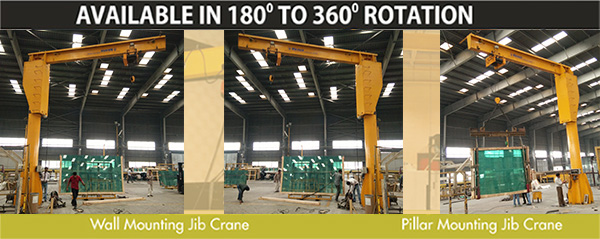
Normal rotations for both mast-style and freestanding jib cranes range from 180 to 360 degrees. The size of the available work area and the type of load movement determine the necessary degree of rotation in any given application.


·      Peak of the Explosion


It might only sometimes be required for a jib crane's boom to reach the ceiling. The location of obstacles, other equipment, and other cranes determines the maximum allowable boom height.


·      Jib Crane Height


A jib crane's height depends on several variables, such as obstacles, the building's layout, the process specifications, and the availability of an electrical supply. Manufacturers work with customers to customize the engineering and design of jib cranes to fit specific operational or process requirements.


·      Service Agreement


The length of a jib crane's boom determines its working height and is adjustable by the trolley's travel distance. Maximum boom length depends on the working area and any nearby obstacles.


Conclusion


The lifting mechanism of a jib crane lowers the overall weight of the object it is lifting using a lattice structure on its extended arm or boom. Jib cranes can improve efficiency, raise workplace safety, and quickly and easily lift heavy objects without manual labour. Because of their durability, they can withstand normal wear and tear from frequent use. You can get in touch with the best Jib Crane Manufacturers In India, the Venus Engineer.

Thursday, 27 July 2023

What Are Jib Cranes? Types, Components, and Uses

Jib cranes are adaptable material handling tools made to lift and transport large objects inside a constrained space. They are frequently employed in industrial settings, storage facilities, building sites, and manufacturing plants. Jib cranes are renowned for their effectiveness, functionality, and simplicity of use. We shall discuss jib cranes, their varieties, essential parts, and many applications in this blog.

Types of Jib Cranes

     Free-Standing Jib Cranes: Jib cranes that stand alone without the assistance of a building or other structure are self-supporting constructions. They are frequently employed in open spaces or places where the building's structure cannot hold the crane's weight. They are fixed to the ground. Due to their ability to rotate 360 degrees, these cranes offer outstanding coverage and material handling flexibility.

     Wall-Mounted Jib Cranes: Jib cranes that are wall-mounted attach to an existing wall or other structure, making them perfect for spaces with little floor space. They can be strategically positioned to cover particular workstations or production lines and give a 180-degree rotation. Jib cranes installed on walls are frequently seen in factories and production lines.

     Articulating Jib Cranes: Knuckle boom cranes, also known as articulating jib cranes, have an arm with numerous articulated or bendable portions. Because of this capability, the crane can be used in applications where obstructions prevent a direct lifting path. Construction sites and outdoor material handling jobs frequently make use of articulating jib cranes.

Key Components of Jib Cranes

     Mast or Pillar: The vertical part of the jib crane that supports and stabilises the boom is called the mast or pillar. Depending on the kind of jib crane, it is firmly fastened to the ground or to the framework of a building.

     Boom or Jib Arm: The boom, sometimes referred to as the jib arm, is the part of the jib crane that extends horizontally and carries the weight. It is fixed to the mast and has free rotation, which enables the crane to reach different places.

     Hoist or Lifting Mechanism: The boom, sometimes referred to as the jib arm, is the part of the jib crane that extends horizontally and carries the weight. It is fixed to the mast and has free rotation, which enables the crane to reach different places.

     Foundation or Mounting Structure: For free-standing jib cranes, a foundation is required to securely anchor the crane to the ground. In the case of wall-mounted jib cranes, a sturdy mounting structure is necessary to attach the crane to the wall or building.

Uses of Jib Cranes

Jib cranes find applications in various industries due to their versatility and compact design.

Some common uses include:

     Material Handling in Warehouses: Jib cranes are commonly used in warehouses to efficiently move and position heavy materials, reducing the strain on workers and enhancing productivity.

     Loading and Unloading in Docks: In dockyards and shipping ports, jib cranes are utilized for loading and unloading cargo from ships and containers.

     Construction Sites: Articulating jib cranes are employed at construction sites to lift heavy building materials to higher levels and access hard-to-reach areas.

     Manufacturing Processes: Jib cranes are integrated into manufacturing processes to aid in the assembly and movement of components during production.

     Maintenance and Repair: Jib cranes are useful for maintenance tasks, allowing technicians to lift and position heavy machinery or equipment for repair work.

Conclusion

Jib cranes are essential material handling equipment that plays a crucial role in various industries. Their ability to efficiently lift and move heavy loads within limited spaces makes them a preferred choice for many applications. Whether in warehouses, manufacturing facilities, or construction sites, jib cranes enhance productivity and improve workplace safety. With a wide range of jib crane types available, businesses can choose the one that best suits their unique lifting needs. If you are looking for good quality Jib cranes, at VENUS ENGINEERS you can get all you need.

Friday, 21 October 2022

Essential Tips You Should Look for When Choosing Jib Cranes

Cranes are the most basic equipment with regard to material handling. Above and Gantry cranes are frequently thought to be the superheroes among cranes, and each superhuman requires a companion, very much like our Jib cranes. Jib cranes assist with enhancing enormous above cranes for all your nearby material handling requirements. They have a great many applications and can be utilized inside and outside. What's more, they are the most affordable and ergonomic material handling arrangement that effectively fixes your lifting hardships.

Understanding The Design of a Jib Crane

Jib cranes can productively help increase human endeavors, handling loads up to SWL 10t. They are helpful for stacking and dumping workpieces or machine instruments and trucks. They can turn into indistinguishable pieces of an independent workstation.


Jib cranes are predominantly separated into two variations, specifically, Point of support Mounted and Wall Mounted. Point of support Mounted Jib cranes are useful when no proper help is free close to a workstation. Then again, wall-mounted jib cranes are great for workstations situated close to walls or vertical designs.


Jib Crane Basics:

Jib crane types include Floor Upheld (Otherwise known as base mounted), Wall Mounted (additionally called Full Cantilever), Roof-mounted (Articulating), Sleeve Mounted, Tie Pole, and Pole Type.


  • Rotational development can be manual, hand-outfitted, or engine driven.

  • Standard list jib cranes come in limits of ½ to 5 Tons and have ranges up to 20 feet.

  • Open-air jibs are best provided with seal welding and a hot plunged electrified finish, particularly for applications in marinas and boatyards.

  • Jib cranes have around 15% of the evaluated load worked in to convey the heaviness of the derrick, and for long-lift raises, the jib limit should be upgraded to convey the additional load of this derrick type.

A jib crane is designed with three primary parts.

  • Masts: They go about as the upward help structure for the arm of the crane, keeping the entire design set up.

  • Jibs: They are the real arm of the crane that turns in a semi-circle and round direction relying on the crane type and application.

  • Hoists: This is the part that does the real lifting and handling for the jib.

  • A jib crane design offers the accompanying highlights.


They can pivot in 360-degree movement, making roundabout developments while handling simpler, faster, and more productive.

The jib crane derrick can stack and dump workpieces on machine instruments or trucks. Jib Cranes designed and designed by ElectroMech can deal with loads up to SWL 10t definitively and productively.


Also Read:- Things To Keep In Mind While Picking Jib Crane Manufacturers


They are low upkeep and proposition consistent tasks for sequential construction systems.


Mast-type jib cranes:

Mast-type jib cranes are actually a hybrid of Floor Mounted and Roof Mounted jibs, with associations with both the floor or establishment and the roof construction of the facility. This assists with better dissemination of the push and the draw of the heap and lessens the weight on the general construction of the facility. While Pole style jibs normally cost more than the Wall mounted style, they can assist with decreasing expenses of the help radiating in recently developed offices or meet a need. At the same time, existing designs can't uphold the power required.

What to consider while choosing a Jib crane for your business?

Consider the accompanying focuses while choosing a jib crane for your working environment.


While searching for a Jib Crane, you want to consider the application and accessible space structure.

The lifting limit, rotational region, general level, work length, and engine power requirements should be thought of.


The equipment ought to adjust to all industry design and security principles.

Venus Engineers, one of India's driving Jib Crane Manufactures, designs and architects the ideal material handling answer for your lifting requirements. Our jib cranes furnished with the best parts, track down applications across an expansive range of ventures and are the embodiment of designing for normalized applications. Contact our specialists today to look into our Jib Cranes and other material handling arrangements.

Monday, 29 August 2022

A Guide to Jib Crane

A jib crane is a sort of crane that regularly ranges between two focuses and can move weighty items. Jib cranes come in different sizes and shapes. Most regularly they are viewed as an outline structure with a one-arm expansion at a point from the fundamental bar. These cranes are useful for moving huge bits of hardware or gear on building locales. They are additionally generally of purpose in distribution centers, production lines, power plants, ports, and numerous different spots where hard work needs to occur.

WHAT IS A JIB CRANE?

A jib crane has a level arm, known as the jib or blast. A jib, which resembles a gantry, upholds a portable derrick that might be on the wall or support point on the ground. A jib's essential capability is in modern settings. For instance, a jib crane can lift weighty items onto high retires or get them across enormous distances.

A jib swings in a circular segment or is held so it considers a more sidelong development. The jib on the crane is a shifted swagger whose capability is to help with the decent pulley lock. More or less, a jib crane is above lifting hardware that is useful in more modest work areas for tedious and explicit lifting errands.

With an essential comprehension of what a jib crane is, you ought to likewise realize how it's made. In contrast with different kinds of cranes, for example, workstation cranes or gantry cranes, the crucial construction plan of a jib crane is easier. Thus, they are additionally more straightforward to work and don't need a lot of upkeep.

JIB CRANE COMPONENTS

Jib cranes are typically very fundamental in plan and development. They are simpler to work and require less fixing than workstations or scaffolds or gantry cranes. This is on the grounds that they have less parts that could fall flat or separate.

THE MAIN COMPONENTS OF JIB CRANES ARE:

    The Reach - An even shaft that swings to and fro on the streetcar. The unsupported or pole jib crane blast can pivot 360 degrees. Though the revolution on a wall or section-mounted crane is somewhere in the range of 180 and 200 degrees.

    Pole/Pillar - This upward bar upholds the blast on frameworks with either a pole or is detached.

    Mobile Hoist - A derrick is a gadget that raises, positions, and brings down a heap.

    Streetcar - The streetcar might be hand-controlled, fueled, or pneumatically worked. The streetcar moves the lift, wire rope or chain, and snares along the length of the blast.

    Electric Collector Rings: - The highest point of the pole can be outfitted with a gearbox to give turn help and permit nonstop blast revolution. Electric gatherer rings or pneumatic aircraft may likewise be added to the top or lower part of the pole. This is to help with pivot and empower consistent 360° blast revolution.

    Controls - The administrators of the apparatus have some control over the revolution of the blast and the development of the streetcar and lifting and bringing down movement of the crane, utilizing a press button regulator. For lifts and streetcars, multi-speed or variable speed controls are accessible.

    Snare Height - The most extreme level of the snare over the base level.

    Turn Stop - A revolution stop restricts the crane's movement before it slams into an adjoining object in the event that the crane is close to a wall or other block.

Every part of a jib crane should be worked to the best expectations and workmanship. Great jib cranes are regularly more costly than different sorts of development hardware. Nonetheless, they are less inclined to encounter personal time due to breaking down.

EXAMPLES OF JIB CRANES IN ACTION

There are various purposes for jib cranes. They can be useful for truly difficult work occupations, notwithstanding assignments that require exact situating or position. For instance, a jib crane is regularly of purpose on building destinations when something has been broken and needs substitution. It's likewise of purpose in distribution centers where materials move starting with one area and then onto the next utilizing a lift toward the finish of the blast. Moreover, jib cranes are additionally of purpose on ships and seaward oil apparatuses to move freight.

SOME EXAMPLES WHERE A JIB CRANE WOULD COME IN HANDY:

    Lumberyard or stockroom - A jib crane can move beds of wood from one region in a distribution center or yard.

    Stockroom rooftop - now and again, the high level is excessively high for laborers to effortlessly reach and requires the utilization of an ethereal lift like scissor lifts or blast trucks. A jib would empower them to do this undertaking without leasing or purchasing extra hardware.

    Fabricating plant - A jib crane can be useful for errands like moving parts from one workstation to another, shipping materials between divisions of a production line, and moving weighty devices inside the office.

    Medical clinic shipping bay - In this present circumstance, it would be hard for workers at the front finish of the harbor to move weighty things from a truck or trailer. The jib crane would empower them to utilize the machine's derrick and streetcar, as well as its blast, to stack these materials into the structure without any problem.

    Development - A jib can be useful for various errands during development that could require an ethereal lift. For instance, the crane could introduce roofing materials on a structure under development or derrick supplies onto the framework.

    Shipyards - A jib crane can be useful for different errands, including lifting, and moving supplies, gear, or materials.

    Galleries - A jib crane is frequently of purpose in lifting things to high roofs in historical centers so laborers don't need to utilize stepping stools or platforms that could harm the shows.

    Retail locations - When now is the ideal time to rework the store, a jib crane can be useful to effectively move racking units and different installations.

WORKING WITH JIB CRANES

In general, utilizing a jib crane can help efficiency and upgrade work environment wellbeing by bringing down representative wounds. Jib cranes are ideal for high-volume lifts and give an ergonomic strategy to shipping material inside a workstation or in the mix with a current above the crane framework.

Thursday, 28 April 2022

Types of Jib Cranes in the Market


There are numerous choices for lifting equipment to assist administrators with taking care of their business more securely and more proficiently. Normally seen in various ventures and tasks, jib cranes are an adaptable lifting choice. Jib cranes can make an underused region of your office into a useful work cell or praise a current upward crane. These cranes can give lifting and taking care abilities inside a machine region, gathering station, or in stacking and dumping regions. Here, we're discussing jib cranes, the various designs accessible, and how they are utilized in a wide range of activities. There are many sorts of jib cranes on the lookout, and probably the most well-known ones incorporate —


Freestanding Pillar Jib Crane


An unattached point of support jib crane is connected to the current built-up substantial floor of your creation office. This kind of jib crane is intended to be introduced at any place in your office. Points of support arrive in an assortment of levels to clear impediments and give the essential lift level to your establishment.


The lift and streetcar travel along with the blast with the capacity to turn the blast up to 360°. At the point when an unattached support point jib crane pivots, the administrator can lift a heap and afterward turn the blast to the area required for the subsequent stage of the cycle. Jib cranes can assist you with supplanting manual lifting processes in your office.


Wall-Mounted Jib Crane


Jib cranes can be joined to the wall of your structure in a wall-mounted jib crane plan. Assuming that your activities have little floor space, this jib crane setup could be the ideal choice for you. Since these are joined to the wall or a mainstay of your structure, they don't occupy the floor room like a detached point of support jib crane. Wall-mounted jib cranes take into account the 180° - 270° degree revolution.


One more viewpoint to consider is the area of your structure's support point. Assuming you intend to add a jib crane to a structure support point, it is conceivable the point of support may not be in the right arrangement to agree with your creation cycle. A wall-mounted jib crane requires a wall or mainstay of your structure to meet demanding details. You will work with your jib provider to actually look at the underlying strength of the wall or building section and decide the mounting equipment utilized.


Jib Cranes for Heavier Capacities


As limits get heavier, the plan of a jib crane changes in various ways, and primary requirements develop. Jib cranes are commonly utilized in applications as much as 2 Tons, yet bigger limits of 5 Tons or more are conceivable.


Manual or Powered Rotation


The Revolution of a jib crane can be manual or fueled. Lighter limit applications can undoubtedly be pivoted the hard way. Heavier applications, like 2 Tons and higher, can be outfitted with controlled revolution for incessant use. Extra choices for turning jibs incorporate movable revolution stops. These cut off the revolution of the blast to stay away from crashes with encompassing equipment.


Turning a jib crane is easier when the heap is nearer to the furthest limit of the blast and more troublesome when the heap is nearer to the support point or wall mount end of the blast. In the event that the jib crane you want will be pivoted physically, turn with the heap near the point of support or wall mount end of the blast ought to stay away from. It is ideal to work most often in the external 66% or less of the jib blast length for manual revolution tasks.